A Paper Prompt or a Quiet Walk? Two Ways to Reflect
Paper prompt or quiet walk: choose writing to sort a clear question, or walking to give unsettled thoughts room, then keep only what helps you move on.
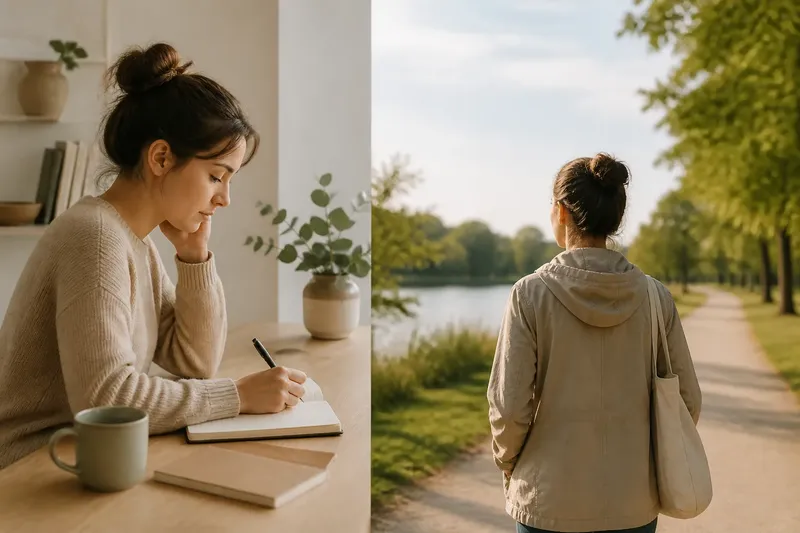
A paper prompt or a quiet walk can shape reflection in different ways: writing gives a thought an edge, while walking lets it wander before you decide what it means. Choose a paper prompt when you want to examine a specific issue; choose a quiet walk when you need room to notice what the issue might be.
If a question feels tangled, a few lines on paper can make its parts visible. If you know the question but cannot force a useful answer, an unhurried walk may help you notice associations a page would leave out. Neither method has to produce a decision.
Choosing a method
Choose a written prompt when you want to examine one issue closely, separate facts from interpretation, or leave a record to revisit. Writing can help when your thoughts keep circling the same sentence: seeing it on the page makes it easier to ask what, exactly, you are claiming.
Choose a quiet walk when you want mental space, a change of sensory input, or permission to follow a thought without committing it to paper. Walking can suit a question that feels emotionally crowded or not yet clear enough to phrase neatly.
Think of the difference as a desk drawer and a window. The page lets you sort what is already there; the walk gives your view a little more room. Use the drawer when the contents are mixed up, and the window when you are not sure what you are looking at.
Writing for clarity
A prompt gives reflection a starting point without dictating its conclusion. Keep it narrow enough to answer in ordinary language. “What has been taking up my attention this week?” is easier to work with than “What should I do with my life?”
Try one question, then write continuously for a short, comfortable stretch. You do not need polished sentences. If you go blank, repeat the prompt in your own words, name what you know, or write “I’m not sure” and continue from there.
Writing is useful for making distinctions. You can separate what happened, what you think it means, and what you are assuming. That can matter when a conversation or decision has acquired a supporting cast of imagined motives.
Writing also leaves a trace. A note from a previous week may show what still matters, what has faded, or which question keeps returning. Treat that record as a snapshot rather than a verdict: thoughts change, and a page can sound more certain than the person who wrote it felt.
Walking for space
Walking can help when reflection needs movement rather than a tighter frame. A familiar route may reduce small decisions competing for attention; a quiet street, park path or open courtyard may be enough. The point is not to find a particularly meaningful landscape. Pavements are permitted.
Take one question with you, then let it loosen. You might notice that the original question is too broad, that a detail matters more than expected, or that you are ready to stop thinking about it for now. Those are useful observations, not failures to reach a grand answer.
Unstructured does not have to mean aimless. If your attention jumps to errands, acknowledge the errand and return to the question when you can. You can also leave the question alone for a while and notice your surroundings. Reflection need not occupy every step.
Making the choice
Say you have been replaying a tense meeting and want to understand what bothered you. Start with the concrete inputs: the meeting, the moment that stayed with you, and your uncertainty about its meaning. Write the prompt, “Which moment stayed with me, and what did I make it mean?” Then separate what was said from what you inferred. If the page produces another round of argument in your head, put it away and take a quiet walk without requiring yourself to settle the matter. The result might be a clearer distinction, a more precise question, or simply a decision to pause; if none emerges, you have still learned that close writing is not helping just now.
For a vague question, walk first and write afterwards. You might return with a more specific prompt, such as “What part of this change am I reluctant to name?” For a question that already feels specific, write first and walk later if you need a pause from close examination.
There is no need to combine the methods every time. One may be enough; sometimes neither fits, and doing something ordinary is the more sensible choice. Reflection is a tool, not an attendance register.
Questions about reflection?
What if writing makes me overthink?
Make the prompt smaller and stop after one clear observation rather than forcing an explanation. If writing turns into self-criticism, describe events in neutral terms or choose a walk instead.
What if I cannot focus on a walk?
Pick a familiar route and carry one question rather than several. If your attention remains elsewhere, let the walk be a walk and return to reflection another time; you do not need to solve the focus problem while moving.
Should I take notes while walking?
Only if notes serve the reflection rather than interrupt it. You could remember a phrase and write it down once you are safely stopped; avoid handling a phone or notebook if doing so distracts you from your surroundings.
How do I know when to stop?
Stop when you have noticed something useful, found a more precise question, or reached the point where more thought repeats itself. You do not need a complete answer before ending the session.
Keeping useful notes
Keep only what will help you return to the question: a sentence, a changed understanding, or a small next consideration. After writing, underline one line that feels accurate rather than the most dramatic. After walking, make a brief note if a thought might disappear before you want to revisit it.
If nothing stands out, leave no record. A blank page or an ordinary walk does not need to become evidence that you failed to reflect properly. A paper prompt or quiet walk is simply a choice about the kind of attention you want: close and visible, or open and moving.
Notice what makes it easier to think, rather than whether it produces an impressive answer. That observation can guide your next choice more reliably than adopting a method out of obligation.